

Local lead generation is how a business turns nearby searchers into customers. In 2026 the bill for it runs anywhere from nothing to $10,000 a month, and where you land inside that range depends on the route you pick. What follows is what it costs, whether the business model still holds up, and what to use in place of rank and rent when you need local business leads.
A plumber or a dentist searching this term wants more work through the door. The next reader down wants to build that inquiry flow themselves and rent it to firms like that one, which is a different job with different economics. Both are here. Where advice that suits one would sink the other, this flags it.
Every headline statistic here is dated and linked. Several of the most-quoted claims in this field fall apart the moment you go looking for the original study, and where that happened we say so instead of repeating the number. Prices and policies were confirmed in September 2026.

Key Takeaways
- Paid search put the median price of a lead at $66.69 in 2026 across 23 categories. Local service trades spanned $29.96 for auto repair up to $131.63 for legal work.
- The "five minutes, 100x better" statistic has no traceable study behind it, and Google documents no ranking benefit from posting weekly. Both claims are everywhere anyway.
- The money-back guarantee that once sat behind Google's Guarantee badge is gone. The badge reads Google Verified now, and most articles still describe the retired version.
- Rank and rent is not illegal, but the listing is where the exposure sits. Google assigns your verification method, and video verification asks you to prove you manage the business.
- 68% of US Google searches ended with nobody clicking through in early 2026, on SparkToro's measure, which makes the listing worth more than the click.
What Is Local Lead Generation?
Local lead generation is the work of turning prospects inside one defined geographic area into paying customers for a business that serves that area. Two groups do it. The local firm winning its own inquiries, and the operator who builds that flow and sells it on.
A roofer working a thirty-mile radius cannot afford a bad month. The number of people who will ever need a roof inside that radius is fixed, and every decision downstream runs into that ceiling. A national campaign can absorb one city going quiet. Thomasnet puts the same point plainly, describing local business lead generation as attracting nearby buyers instead of a national audience.
How Local Lead Generation Works, Step by Step
Every local lead generation system runs through the same four stages:
- Search. Somebody nearby looks for what you sell, or you go looking for companies close by that fit your customer profile.
- Capture. Give that person somewhere to land and a reason to hand over their details, whether that is a Business Profile listing, a location page, a quote form, or a phone number.
- Qualify. Work out which inquiries are worth pursuing, on service area, budget, timing, and whether the job is one you want.
- Convert. Follow up quickly, keep following up, and move the qualified inquiry to a booked job. Our guide to the stages of a lead generation funnel covers the mechanics.
The four stages of a local lead generation system
The channels that feed those stages differ a lot on cost and on speed, and that should decide the order you build them in.
| Channel | Cost model | Time to first lead | Best for |
|---|---|---|---|
| Google Business Profile and Map Pack | Free, costs your time | Days to weeks | Every local service business, before anything else |
| Google Local Services Ads | Per lead, not per click | Days | Home and field services that can take the calls |
| Local SEO and location pages | Time upfront, low to sustain | Months | Compounding demand you stop paying for |
| Geo-targeted paid search and paid social | Per click or impression | Days | Buying volume fast inside a tight radius |
| Reviews and referrals | Effectively free | Weeks | Trust-driven purchases and repeat custom |
| Outbound and LinkedIn | Time, plus tooling | Weeks | Local business-to-business service contracts |
Timings follow CUFinder's channel-by-channel breakdown of time to first lead. One row there carries a correction most write-ups have missed. Google has discontinued the money-back guarantee that sat behind the old Google Guarantee badge, the one that labeled screened providers Google Guaranteed. It reads Google Verified now. Plenty of guides published this year still describe the retired version.
How Do You Generate Leads by Zip Code or City?
Generating local leads by zip code or city means setting the radius or postal codes you tell the ad platform to serve, building landing pages around the specific place and not a generic city name, and running call tracking numbers that show which area produced which inquiry. Align all three and you can see which zip codes pay for themselves.
Plenty of operators respond by spinning up a page for every settlement within reach. Google calls that doorway abuse when the pages are near-identical and exist only to catch place names, and the detail is below. A page passes on evidence. Jobs you actually did in that town, prices that apply there, a named person to ring, and photos that could not have been taken anywhere else.
Local Lead Generation vs. National and B2B Lead Generation
National and B2B lead generation chase the biggest addressable market they can reach. Locally the market is fixed. You get judged on how completely you cover it, and that one difference resets your tooling, your budget, and what a good month even looks like.
A national program buys reach and tolerates a low hit rate. Inside a service area you are buying coverage of a list you can actually finish, and the budget is capped by whatever demand the area throws off in a month. The scoreboard moves too. Cost per lead is the number a national campaign lives on. The local equivalent is how much of the addressable base you have actually contacted, and that one is a great deal harder to flatter.
The UK Business Population Estimates for 2025 counted 5.7 million private sector businesses, but 4.3 million of them, roughly 75%, employ nobody beyond the owner. US counts from the SBA Office of Advocacy tell the same story at a different scale. That changes the arithmetic. Strip out the sole traders who will never buy what you sell and a metro that looked like a hundred thousand businesses turns into a few thousand worth calling, a list one person can realistically work through.
Is Local Lead Generation a Good Business Model? Pros and Cons
Local lead generation is a viable business model with a genuinely low barrier to entry, and it fails far more often than its promoters admit. Job value decides most of it. The rest comes down to how crowded the area already is, and whether you can stay reachable when the phone rings.
The phrase carries two meanings and they get mixed up constantly. Lead generation as a business opportunity means building the inquiry flow yourself and then renting or selling it to local firms, which is the rank-and-rent and agency route. Buying leads means paying somebody else for inquiries that arrive ready-made. Costs, risks and skills all differ, and most of the disappointment in this field comes from people who signed up for one and got the other.
| In its favor | Against it |
|---|---|
| Core tools are free. A claimed Business Profile still beats most paid tactics and costs you nothing. | Ramp-up is slow and self-funded. One forum account describes two years of the work making no money. |
| High-margin trades can afford to pay for inquiries, which is what makes the model work at all. | You are on call. The pressure to pick up does not switch off at six in the evening. |
| Test campaigns run at cost, or on commission, let a first client say yes without risking anything. | Cold pitching lands badly, and reference work alone rarely persuades a busy owner. |
| One trade worked properly compounds, because proof in a niche sells the next client in it. | Seasonality and saturation vary hugely by trade and area, and both are easy to misjudge. |
Pros of Local Lead Generation
Startup cost is close to zero. The core channel is a free listing and the ad budget is optional. Sticking to one trade is what gets you past the first client, because the roofer you got results for is the reference the next roofer actually wants to hear about, and general marketing credentials do not substitute for that. All of it rests on picking a trade with margin in it. The numbers only work when one job is worth enough that the owner would happily trade a slice of it for a booked appointment.
Cons and Common Failure Points
The ramp-up is long and unpaid. Cold pitching lands flat, and being expected to stay reachable at all hours wears people down. That comes from one public r/b2bmarketing discussion plus a thread on r/LeadGeneration, so treat it as testimony and not data, although the two threads do corroborate each other. One operator described being "constantly on the clock", because a missed callback is money somebody else collects. Someone else had paid a part-time cold caller £500 a month for four months, £2,000 in total, and got about five calls and no clients out of it, with Instagram ads running alongside that produced no inquiries at all. A third warned that rank and rent "takes months to see results, and you need cash flow now".
Is Local Lead Generation Worth It in 2026?
Yes, where one customer is worth hundreds and not tens, and somebody answers inquiries the same hour. No, in a thin market, or when the inquiries are bought from platforms that sell the same job to several of your competitors. What a lead costs matters far less than those two conditions. So does which channel produced it. Smaller operators may find our guide to affordable lead generation for small businesses a better starting point than agency-scale tactics.
How Much Does Local Lead Generation Cost? Pricing Models Explained
Local lead generation is sold four ways: per lead, on a monthly retainer, as a percentage of ad spend, or as a hybrid. Paid-search leads had a median cost of $66.69 across all industries in 2026, and managed campaigns run from about $500 a month to $10,000 or more.
Everything below is priced from the buyer's side, meaning what a local business pays to get inquiries. If you sit on the other side of that transaction and want to know what to charge, our guide to agency pricing and delivery for lead generation services covers the seller's view.
- Pay per lead
- You are billed per inquiry, commonly $20 to $500 depending on trade, and nothing when none arrive. The unit price is predictable. Nobody tells you how many rivals were sold the same lead.
- Monthly retainer
- A fixed monthly fee covering strategy, management and reporting. Freelancers and small campaigns run roughly $500 to $3,000, and agency-level multi-channel work runs $3,000 to $10,000 or more.
- Percentage of ad spend
- The manager takes 10% to 20% of ad spend. Easy to calculate, and it quietly rewards a bigger budget instead of a cheaper lead, so pair it with a cost-per-lead target.
- Hybrid
- A smaller base retainer plus a per-lead or per-booked-job payment. Risk gets split and seasonal cycles are easier to ride out. Agree in writing what counts as a lead before you sign anything.
No public benchmark study covers retainer or per-lead pricing for local lead generation. The bands above are the ones quoted across agency rate cards and lead marketplaces, checked September 2026. These are going asking prices. Nobody has measured the averages, so work back from job value using the paid-search medians below.
Pay-Per-Lead Pricing by Industry
Across the local service verticals below, paid-search cost per lead ran from $29.96 in auto repair to $131.63 in legal services in 2026, against a $66.69 median across all 23 categories WordStream measured. Legal was the most expensive category in the entire dataset. The cheapest, Arts and Entertainment at $26.84, is not a local service trade at all. Paid search is the benchmark here because it is the one price published consistently and at scale. WordStream's 2026 report covers 13,474 US search campaigns from April 2025 to March 2026, and reports medians, so a handful of outliers cannot drag the figure around.
| Vertical | Median CPL | Why the vertical buys leads | Source |
|---|---|---|---|
| Attorneys & legal services | $131.63 | One retained case can be worth five figures. | WordStream 2026 |
| Real estate | $102.51 | Commission on a completion dwarfs the inquiry cost. | WordStream 2026 |
| Home & home improvement | $90.92 | High job values, repeat work, fiercest local competition. | WordStream 2026 |
| Dentists & dental services | $72.97 | A new patient is a multi-year relationship. | WordStream 2026 |
| Restaurants & food | $30.57 | Thin margins, so it works only on cheap inquiries and repeat custom. | WordStream 2026 |
| Automotive repair & service | $29.96 | Urgent, local and recurring, so it converts best of any category. | WordStream 2026 |
| All industries | $66.69 | Median across 23 categories. | WordStream 2026 |
Figures are medians from WordStream's 2026 Google Ads benchmarks, published May 2026. UK advertisers should expect a different picture. LocaliQ's 2026 UK paid advertising benchmark report is the closest equivalent, though it reports click-through rate, cost per click and conversion rate rather than cost per lead.
Google does not publish per-lead prices for Local Services Ads. The rate is set by job category and service area, you are charged when a customer calls or messages rather than when they click, and invalid leads can be disputed for a credit. That means the paid-search medians above are a proxy for what an inquiry costs in a vertical, not a quote for LSA itself.
Read that table backwards and it doubles as a niche-selection guide for anyone selling leads instead of buying them. The verticals paying most per inquiry are the ones that can afford to pay you, which is why legal, real estate and home improvement dominate rank-and-rent portfolios and restaurants do not.
Monthly Retainer and Agency Packages
Starter and single-niche campaigns are quoted at $500 to $800 a month. Growth packages with better qualification and reporting sit around $1,200 to $2,000, and multi-channel agency work starts near $3,000 and climbs past $5,000. Clicks Geek, cited most often here, publishes no rate card at all. It steers buyers toward monthly ad budgets of $2,000 to $3,000 and holds Google Premier Partner status, which Google defines as being in the top 3% of participating companies within a given country, assessed annually. Its own site claims the top 1% worldwide. That sharper figure belongs to the agency, and Google does not publish it.
How Much Should You Pay for a Lead?
Work the ceiling out per booked customer rather than per inquiry. Keep total acquisition cost under about a tenth of job value, then divide by your close rate. At one in five that allows roughly 2% of job value per inquiry, so about $200 on a $10,000 legal case and about $8 on a $400 repair. That is why a $131.63 legal lead is sensible and the same price on a $200 job is not. Auto repair only clears $29.96 an inquiry on a higher average ticket, a close rate well above one in five, or both, so run your own numbers before assuming the category rate fits your shop.
Watch the units while you do it. A cost per lead is not a cost per customer, and a data record has not even become a lead yet. Count them apart: raw records, then contactable records, then replies, then booked jobs. Only the last two let you weigh outbound prospecting fairly against paid search. Whichever route you pick, the list ages. ZeroBounce puts email list decay at 23% a year, so budget for refreshing it.
Alternatives to Rank and Rent: What Should You Use Instead?
Rank and rent means building a website for a local service, ranking it, and keeping the site while you rent the inquiries it produces to a business in that trade. "Alternatives to rank and rent" then splits in two, depending on which side of the deal you are on. Want another way to build a lead business? The realistic options are an agency retainer model, a productized service, micro-SaaS, or affiliate content sites. If the goal is simply another source of local leads, it is Local Services Ads, shared marketplaces, and self-serve business data you extract and own.
What Is Rank and Rent, and Why Look for Alternatives?
Rank and rent's appeal is owning an asset that pays you monthly instead of selling hours. Rank and Rent HQ, the page AI assistants cite most often on the topic, reports that a ranked site "commonly rents for a few hundred to a couple thousand dollars a month" and that ranking usually takes "a few months, often three to six" in a beatable market.
Those months come before any revenue. The model needs cash flow you may not have, and the Business Profile attached to the site carries a compliance risk covered later. Rank and Rent HQ itself concedes the approach has changed: "AI Overviews and tougher local SERPs killed the thin, spun-content approach".
Take the business-model reading first. An agency retainer pays fastest and needs almost no capital, though you are straight back to trading hours for money and every client is a churn risk. A productized service is one repeatable offer at a fixed monthly price, usually Business Profile management, so the revenue recurs and nothing has to be quoted bespoke. Everybody else sells that identical package, which shows up in the price. Micro-SaaS pays the best of the four, takes the longest to pay anything at all, and asks for product skills most lead-gen operators do not have. Affiliate content sites need no clients and go quiet once they rank. Then you are holding demand rented from Google with no contract, the exact exposure that made rank and rent look risky in the first place.
Comparing the Alternatives Side by Side
| Route | Cost model | Time to first lead | Who owns the data | Scalability |
|---|---|---|---|---|
| Rank and rent site | Your time plus hosting, then rent in the low hundreds to low thousands monthly | Three to six months | You own the site and the inquiries | Slow, since each new site starts from zero |
| Google Local Services Ads | Per lead | Days | Google. Contacts reach the profile the customer picked | Capped by service area and verification |
| Agency retainer | $500 to $10,000+ monthly | Weeks | Depends on the contract, so read it | Scales with budget, not effort |
| Shared marketplaces (Angi, Thumbtack, HomeAdvisor) | Per lead | Days | The platform, and the inquiry is commonly resold | High volume, falling close rate |
| Self-serve business data (Lead Scrape) | Flat annual license, unlimited searches | Same day, but you run the outreach | You keep and reuse the exported list | Limited by your outreach capacity |
Time-to-first-lead estimates draw on CUFinder's channel comparison and Rank and Rent HQ's own timeline. The marketplace row catches people out. Inquiries arrive immediately, then the shared-lead apps resell the same one to your rivals and the close rate collapses.
Which route fits depends on what you are short of. No time, buy leads. If money is the tighter constraint, build the listing and chase reviews, and if the problem is simply that you do not want your pipeline rented from a platform, build a list you own. The data tools in that last category are compared in our roundups of Apollo alternatives and how Outscraper compares, and what the law allows when collecting business data.
That last option is where Lead Scrape sits, and the section below sets it against the other four.
How Does Lead Scrape Compare to Other Local Lead Generation Options?
Lead Scrape is a desktop tool that pulls local business records, plus the people who work at those firms, out of several B2B directories at once and charges one flat annual license for it. That places it in the data layer of local lead generation, well away from agencies and ad platforms. It sends no email and places no calls, so you get the list plus the job of working it.
When to Use Lead Scrape vs. an Agency or Rank-and-Rent Site
An agency is the answer when the budget exists and the hours do not. Rank and rent goes the other way: little cash, and months of unpaid work before anything lands. A data tool answers a different question again. Somebody is already willing to make the calls and just needs a clean list of who to ring, and of the three routes it is the only one where you keep the output after switching providers.
Apollo and ZoomInfo are people-first databases, queried by job title, seniority or headcount, and thin on independent local firms. Listing scrapers cover small businesses well and often hand back the listing with no human being attached to it. Lead Scrape returns both. The Companies tab holds address, phone, website and category, and alongside it a Contacts tab lists each person by name, role, work email address and LinkedIn profile. For the wider category see how the main lead generation tools stack up and our overview of what a lead extractor does.
Lead Scrape Pricing and Data Model vs. Pay-Per-Lead Services
Lead Scrape is a flat annual license. Standard costs $97 and merges three directory sources. Business costs $247, merges seven, and adds bulk searches across a whole state, county or region. Searches are unlimited and there is no per-record charge, which is the structural difference from pay-per-lead and credit-metered services.
What a flat license costs in paid-search leads
Comparing a flat license against a per-lead price only works as a break-even count. At the 2026 median paid-search cost per lead of $66.69, a year of Lead Scrape Standard at $97 costs less than two paid leads. In home improvement it costs a little over one.
Sources: WordStream 2026 Google Ads Benchmarks and Lead Scrape's list price, checked September 2026. This is arithmetic across two separately sourced figures, not a measured cost per lead: an extracted record is not a qualified lead, and outreach time sits outside the license fee. The two figures come from separate datasets and have not been merged into a single rate.
What a search returns varies enormously by trade, so one run proves nothing on its own. Here is one anyway, dated. In July 2026 we ran a single "HVAC contractor" search for Austin, Texas on the Business edition, with Emails and Contacts plus Verify Emails switched on. Under five minutes later it had returned 550 businesses and 3,386 named people working at them.
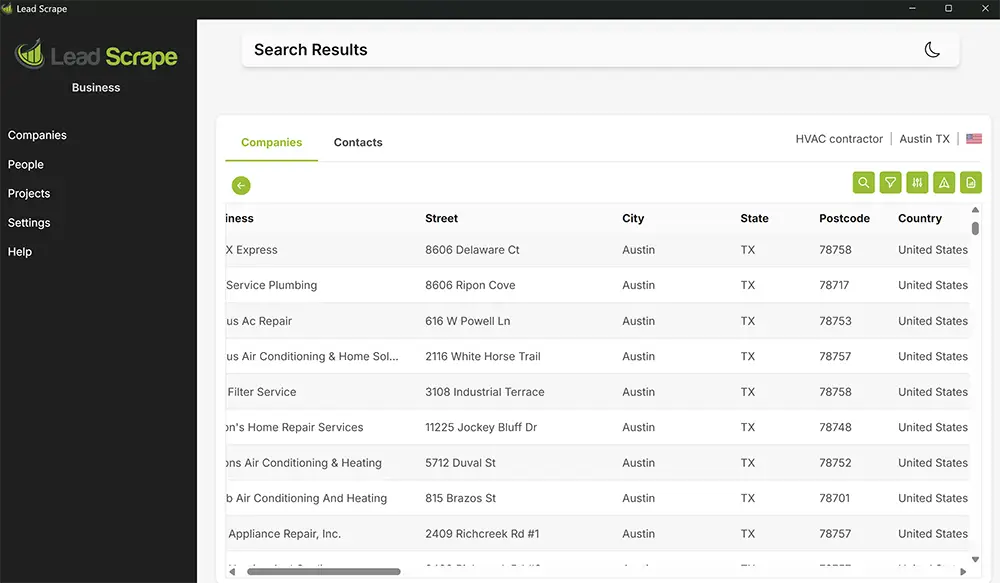
At a contracting firm the useful contacts usually run to three or four people, typically whoever owns it, whoever signs off on spending, and the service managers who scope the work. Another trade in another city returns a different count. One dated search, then, and nothing more. See how a flat annual license compares with a monthly retainer on the pricing page.
Local Lead Generation Reviews: What Do Users Actually Say?
Public sentiment on local lead generation is mixed, cautiously positive from experienced operators and undercut by the outcomes in the same threads. The people recommending the model most confidently are frequently the ones selling training in it.
Reddit and Forum Sentiment
Searching for this turns up far less than you would expect. One substantial r/b2bmarketing discussion of 19 comments and one r/LeadGeneration post survive, after excluding an apparent vendor plug and an off-topic listicle. Two threads, then, and not a survey.
Business Profile optimization "costs nothing and actually works for local". Local Services Ads "convert like crazy for home services and the barrier to entry is low". Those two come up more than anything else across both threads. Offering a first client a test campaign at the cost of ad spend, or purely on commission, removes their risk and produces a case study fast. Read the advice against the outcome, though. The person who started the thread gave up on the model anyway, for the three reasons set out above.
Red Flags in Local Lead Gen Courses and Programs
Ippei Kanehara's local lead generation program is the best-known paid training in this field, and Rank and Rent HQ is the most-cited free one. Between them they shape most of what gets taught. Ippei now publishes the price, at $3,000 as a one-time payment or $500 a month for seven months, with $600 a year afterwards to stay in the community. That is worth knowing, because affiliate review sites still quote figures from roughly $1,500 to nearly $8,000 and no two agree. Several are describing a different, retired program. That leaves a few things worth watching for.
- Second-hand pricing. Where a course withholds its fee until an application call, every published number is somebody's guess. Check the vendor's own page before trusting a review's figure.
- Income claims without verifiable accounts. Screenshots are not accounts. Ask what happened to the people who never made it into the testimonials.
- Reviews carrying affiliate links to the product being reviewed, which describes most of the results for these programs.
Google Business Profile Verification Rules in 2026
As of 3 September 2026, Google assigns your Business Profile verification method. You get no say in it. Google states that they "are automatically determined by Google and can't be changed", and that the options depend on business type, public information, region and business hours.
The routes in use are phone or text, email, live video call, and mail, with Search Console verification and bulk verification available as expedited options for eligible businesses.
What Changed with GBP Video Verification
Nothing in the published rules changed during 2026. Video verification still catches people out, because it cannot be prepared in advance and cannot be declined. Google's video recording verification guidance requires footage captured live on a mobile device, unedited, in one take with no breaks, and at least 30 seconds long. Pre-recorded files are not accepted.
The recording has to establish where the business is, that it exists, and that you manage or represent it. A storefront shows signage with the business name on a permanent fixture matching the profile. No premises? Then it is street signs or landmarks at the registered address, followed by tools, equipment, workspace, branded clothing or business cards. Google explicitly warns against filming empty land or locations with no clear markers.
GBP Guidelines Relevant to Lead Generation Businesses
Operators who build profiles on behalf of somebody else hit these rules first. A profile is for a business with premises customers can visit or one that travels to customers, and service-area businesses should keep one profile for the central location with a defined service area. Third parties managing a profile must have the owner's consent. Google "reserves the right to suspend access to Business Profiles" where the guidelines are broken.
No published Google source states that posting weekly lifts local rankings, and none states that visibility drops during listed closed hours. Both claims circulate widely. The evidence for both is practitioner survey data, and the next section says what that data actually shows.
Local Lead Generation and Local SEO Trends for 2026
Most local searches now end inside Google, and the odd part is that the ranking fundamentals have not moved to match. SparkToro measured 68% of US Google searches ending without a click in the first four months of 2026, while Whitespark's practitioner survey still ranks category, proximity and business title above every content tactic.
AI Search, Zero-Click Results, and What They Mean Locally
SparkToro's 2026 zero-click study, built on Similarweb clickstream data, puts the figure at 68%, up from just over 60% in 2024 and 45% in 2016. For a local business that means the listing now matters more than the website, because the name, rating, hours and phone number all get read and acted on without anyone visiting your site.
The "profile freshness" claim falls down in the same place. It circulates as "Google heavily prioritizes active profiles, so post weekly", and Google's own guidance on improving local ranking lists relevance, distance and prominence and stops there. Google does say complete, accurate information helps relevance. It makes no claim about posting frequency. Whitespark's 2026 Local Search Ranking Factors survey puts frequency of Google Posts at position 148 and recency of uploaded photos at 89, both far behind primary category, proximity and keywords in the business title, so post for the customers who read them rather than for the map pack.
The related "closed hours penalty" claim fares better than expected. No Google documentation supports it, and we went looking for a primary source in September 2026 without turning one up, but the same Whitespark survey ranks "Business is Open at Time of Search" fifth of every factor it measured. Working local SEOs rate it that highly, and Google has never documented the effect either way.
Google's Spam Policies on Scaled Content in Local SEO
Google's spam policies define scaled content abuse as "when many pages are generated for the primary purpose of manipulating search rankings and not helping users", and doorway abuse as sites or pages "created to rank for specific, similar search queries" that "lead users to intermediate pages that aren't as useful as the final destination".
Google never names rank and rent, so the interpretation is left to you. A single well-built site for one trade in one town is not a doorway. A network of near-identical pages differing only in place name, each forwarding calls to a business elsewhere, matches the doorway definition almost word for word. Those pages are the intermediate stop, and the caller wanted the contractor.
How to Qualify and Convert Local Leads
Qualification for local work is simpler than B2B scoring. Service area, job type, budget and timing are the whole of it, and once you have those four you know whether to quote. Our guide to scoring and prioritizing leads covers the framework in full.
Conversion starts on the page they land on, before anybody picks up a phone. Put the phone number above the fold as tappable text, not an image, and name the service area the way somebody would say it out loud. Offer one action, not three. Then show that you have worked nearby: photographs, a street or neighborhood name, a recent review. Those last two, the tappable number and the local proof, are what usually goes missing on a page that gets traffic and no calls.
The 5-Minute Rule for Leads
Responding within about five minutes genuinely improves your odds, but the specific claim that it makes you "100 times more likely to convert" has no traceable primary source, and we could not find one as of September 2026.
This one is worth being precise about, because the number turns up everywhere, including in Google's own AI-generated summaries. Trace it and you get a loop. The multiplier only ever appears in commercial blog posts citing each other, and one of them openly states its figures came from an AI query rather than a study. The oldest real research behind the idea dates to 2007, too old and from too different a market to quote as a 2026 benchmark. There is no replacement figure here. We went looking and found nothing credible. The forum accounts at least show the cost of the opposite: the operator quoted earlier stayed "constantly on the clock" for a reason, and it was not superstition about a five-minute window. Ring back while the caller is still collecting quotes, and treat any specific multiplier you read as unsourced.
How Many Leads Can You Realistically Generate Per Day?
For one person working a single town and trade, one to five qualified inquiries a day is a realistic steady state, and many days produce none. How many people in your area go looking each month sets the ceiling. Working harder does not raise it. Once inquiries arrive consistently, a structured follow-up and nurturing sequence matters more than adding channels.
Why Reviews and Reputation Management Drive Local Lead Conversion
Reviews are the conversion step most local businesses skip. BrightLocal's 2026 survey found 97% of consumers read reviews for local businesses, and 47% will not use a business with fewer than 20 of them.
Review Volume, Star Ratings, and Purchase Likelihood
In BrightLocal's Local Consumer Review Survey, published February 2026, 68% of consumers said they would only use a business rated four stars or better, up from 55% a year earlier, and 31% now hold out for 4.5 stars, up from 17%. That threshold has moved fast. It means a 3.9-star profile with plenty of reviews can convert worse than a 4.6-star profile with fewer, because volume gets you into the consideration set and the rating decides it from there. Replying to reviews, the critical ones included, is the cheapest visible signal you control.
Ask the moment the job is finished and the customer is visibly pleased. Text them the Business Profile short review link the same day so it is one tap on the phone they are already holding, and ask after the awkward jobs too, not only the ones that went well. Keep it going week to week. A dozen reviews in a fortnight followed by six months of silence reads as suspicious to buyers and to Google alike.
Local Lead Generation Courses and Training: Are They Worth It?
Local lead generation courses are rarely worth a four-figure price, because what they teach is documented free by Google and by the local SEO research community. The exception is a course bought for accountability and a peer group rather than information.
Paid training covers niche selection, ranking a local site, and pitching owners. The first and third are judgment. You pick those up faster by calling ten firms in your trade than by watching modules, and the ranking half is already written down, for nothing, by Google and Whitespark.
A Business Profile costs nothing and a landing page can be built free. Rank tracking, citation management and review monitoring are what BrightLocal sells, and that is a modest monthly subscription rather than a capital outlay. A whole working stack comes to less than most course fees, counting the free Business Profile, a landing page on something like Carrd or WordPress, a CRM such as GoHighLevel, call tracking such as CallRail, rank and review monitoring from BrightLocal, and a data tool for the list itself. Before paying for training that recommends a stack, read a neutral comparison of lead generation software and buy only what the plan needs.
A claimed and accurate listing counts for more than most paid tactics. So do reviews you asked for by hand, a list of the right businesses to call, and a phone somebody answers inside the hour. None of that is interesting work. The forum threads quoted earlier are full of people who lost on the last one. Lead Scrape handles the third item. It reads across a set of B2B directories and assembles the companies near you plus the staff attached to them. You pay once a year and nothing is metered per row. The free trial will show you what one search in your own trade and town actually returns, and the plans and pricing page sets the two editions side by side.