

According to Salesforce's State of Sales report, sales reps spend only 28% of their week actually selling. Automated lead generation (also called automated prospecting) claws back part of the other 72%. Hand the repetitive stretches of the pipeline to workflow tools, CRM triggers, and email sequence platforms, and a small team gets those hours back for the part of the job that needs a person.
Some stages hand over cleanly. Others will park your sending domain on a blacklist if you switch them on before the underlying process works. Everything below is rule-based: triggers, scheduled tasks, and sequences that fire when a condition is met. No AI scoring, no machine learning. For the wider strategy around it, see our complete guide to B2B lead generation.
Key Takeaways
- Sales reps spend only 28% of their week actually selling. Give the admin and prospecting chores to software and some of the other 72% goes back into conversations.
- Six stages automate cleanly. Taken in pipeline order they are lead extraction, data enrichment, CRM data import, email follow-up sequences, follow-up task creation, and lead routing.
- Zapier, Make.com, and n8n wire your lead sources into a CRM and an email platform with no custom code involved.
- The basic chain, Lead Scrape extraction to CRM import to email sequence, can be built and tested in one to two days.
- Small teams and agencies gain the most. There is nobody spare to absorb the admin load, and for an agency every new client is a copy of a template that already exists.
- Never automate a process you haven't already proven by hand. Automating a workflow that doesn't work only means it fails on more contacts.
What Is Automated Lead Generation?
Automated lead generation uses software tools and workflow triggers to handle repetitive prospecting tasks without manual input at each step. Drop a CSV into a shared folder and that one action imports the whole list into your CRM, assigns each contact to a rep, and starts a follow-up email sequence. The row-by-row copying most small teams still do by hand disappears.
The "automation" here means rule-based workflows: if this happens, then do that. New file lands in the folder, contacts get imported. When the same person opens one of your emails three times in a week, a call task appears on the assigned rep's list. Reply mid-sequence and the next send never goes out. Each one is a value checked against a condition, so the answer comes back true or false and nothing in the chain has to make a judgment call.
Which is why none of this needs a data science background or a big budget. You need a workflow tool, a CRM, and an email platform. Plus clear rules for how data moves between them. A two-person sales team can start on Monday and have the whole thing live by Wednesday.
Where AI-powered prospecting sits
This article doesn't cover AI-powered prospecting, machine learning scoring, chatbot capture, or predictive analytics. Those make judgment calls off data patterns, which is a different problem and belongs in its own piece. What follows runs on ordinary tools. A small team already owns most of them, and the rest come to under $200 a month put together.
How it differs from marketing automation
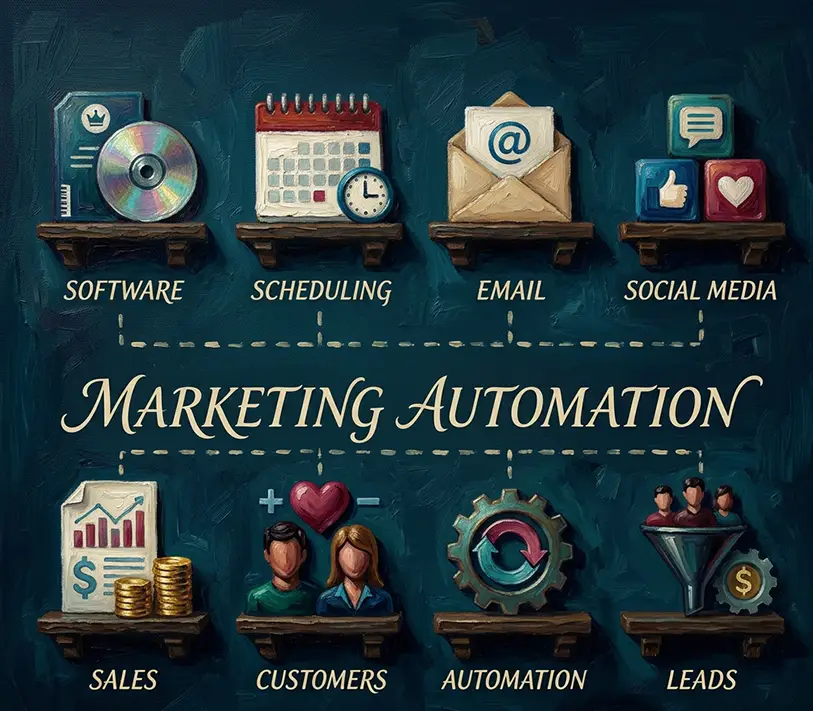
Marketing automation covers the broader funnel, so content scheduling, social posting, ad management and retention emails all sit under it. Lead generation automation is one slice of it: list building, CRM import, outreach, reply routing. For a small B2B team the narrow version pays back first, because it produces contacts a rep can call this week.
Why Should Small Teams Automate Lead Generation?
Two or three people run the whole sales operation at most small B2B companies, and those same two or three handle prospecting, outreach, follow-up, CRM upkeep, and closing. Nobody is spare. Take the repetitive half away and the same week produces 200 worked leads instead of 50, because an hour saved is a bigger share of everything you have.
HubSpot's research on sales automation shows sales professionals using AI or automation tools save around two hours and fifteen minutes a day on manual work: data entry, note-taking, scheduling. Not all of that is prospecting. The lead generation slice on its own is worth 8 to 12 selling hours a week to a small team where everyone wears four hats. McKinsey's 2024 B2B sales research puts the efficiency gain from arming a sales team with technology at a consistent 10 to 15 percent, with reps spending more time in front of customers and less on back-office work like pipeline management and invoicing.
I'd put a wide error bar on that 8 to 12 hour figure. It holds for a team already running a CRM and already sending sequences. A team coming off spreadsheets gets less back in month one, because the saved hours go straight into setup and into fixing the field mapping.
Two people getting back 8 to 12 hours a week, at a contractor rate around $75 an hour, is $2,400 to $3,600 a month of recovered selling time. The $75 is my own placeholder, not a benchmark. Substitute what an hour of your team's time actually costs and the multiple moves, though it stays comfortably above 1. The stack that buys it runs $50 to $150. Take the least flattering reading, 8 hours back against the full $150, and you're at roughly 16 times return before a single extra deal closes.
The agency multiplier effect
Run an agency doing lead generation for five clients and every manual step happens five times over. Five CRM setups, five spreadsheet imports, five sequence configurations, and a separate reminder list per client that nobody wants to own. Automation collapses that into one template. Clone it per client, change the targeting, and signing a sixth client turns into a 30-minute setup where it used to be a two-day project.
Copy-pasting CSV rows into a CRM. Or digging back through a March thread because somebody promised something and nobody wrote it down. Those are the jobs to hand over first, before you touch anything that involves talking to a prospect.
"Automation applied to an efficient operation will magnify the efficiency. Automation applied to an inefficient operation will magnify the inefficiency."
Aaron Ross made a version of this argument in Predictable Revenue: teams scaling outbound have to split the pipeline into specialized jobs (list building, cold outreach, qualification, closing) before they hang tools off any of them. For a small team the order flips. Work each step by hand, see which one breaks first, then automate around what you learned.
What Parts of Lead Generation Can You Automate?
Six stages take to automation well. List building, data enrichment, CRM import, email sequences, follow-up task creation, and lead routing. Each one has a known input and a predictable output, which is the whole requirement for running it unattended.
| Stage | Manual Version | Automated Version | Time Saved per Week |
|---|---|---|---|
| List building | Google searches, LinkedIn browsing, copying contacts into spreadsheets | Batch extraction with Lead Scrape filtered by industry, location, and company size | 3 to 5 hours |
| Data enrichment | Looking up websites, verifying emails, finding phone numbers one by one | Built-in email verification during extraction, plus company data appended from the lead tool output | 2 to 4 hours |
| CRM import | Manually entering contacts into HubSpot, Pipedrive, or a spreadsheet | Zapier/Make.com watches a folder for new CSV files and creates CRM records automatically | 1 to 3 hours |
| Email sequences | Writing and sending individual follow-up emails from your inbox | Pre-built multi-step sequences in Instantly or Smartlead triggered by CRM status | 3 to 6 hours |
| Follow-up tasks | Checking open rates manually, creating reminders in your calendar | CRM creates a call task when a lead opens an email 3+ times or clicks a link | 1 to 2 hours |
| Lead routing | Manually assigning leads to team members based on territory or industry | CRM rules auto-assign new contacts by region, company size, or round-robin | 30 min to 1 hour |
Across all six that comes to 10 to 20 hours a week for a small team, depending on lead volume. You don't need all six. Two of them, CRM import and email sequences, cover the cost of the whole stack on their own.
What to keep manual
Four parts of the job are worth keeping in human hands, because the context they run on lives in somebody's head and never makes it into a CRM field.
- Lead quality review: scan the extracted list before importing and pull the duplicates, the obvious mismatches, and anything outside your ICP.
- Personalized first lines: a merge tag will drop the company name into your opening sentence and stop there. Saying something true about that company is the part you write yourself, and readers can tell within a line which one they got.
- Live sales conversations: the moment a prospect replies, a person takes over. Auto-replying to somebody who just engaged reads as robotic and spends the trust that reply represented.
- Relationship follow-ups: a note after a demo has to pick up what was actually said on the call. Send one that could have gone to anybody on the list and you undo the demo.
What Are the Best Lead Generation Automation Tools?
The lead generation automation tools worth using in 2026 split into four categories: workflow connectors that move data between apps, CRMs with automation built in, email sequence tools for multi-step outreach, and extraction tools that build the contact list in the first place. A complete pipeline needs one from each.
| Category | Tool | Best For | Starting Price |
|---|---|---|---|
| Workflow Automation | Zapier | Largest app library (8,000+), easiest setup for non-technical users | Free (100 tasks/month) |
| Make.com | Visual workflow builder with branching logic, better value at higher volumes | Free (1,000 ops/month) | |
| n8n | Self-hosted open-source option with no per-task fees, full data control | Free (self-hosted) | |
| CRM Automation | HubSpot CRM | Free tier with contact management, deal pipeline tracking, email logging, and forms (workflow automation in paid tiers) | Free (core CRM) |
| Pipedrive | Sales-focused CRM with pipeline automation, activity reminders, and email sync | From $14/user/month (Growth tier from $28, includes Automations) | |
| Email Sequences | Instantly | Cold email at scale with built-in warmup, deliverability monitoring, and rotation | $37/month |
| Smartlead | Multi-inbox rotation, unified reply management, high volume capacity | $39/month | |
| Lead Extraction | Lead Scrape | Batch B2B contact extraction with built-in email verification, CSV export | Free trial |
I should flag that Lead Scrape is the company I write for, so treat the extraction row as an interested opinion and check it against the alternatives. The other three categories are tools we pay for like anyone else, and each one works the same way whatever sits in front of it.
A working stack (workflow tool, CRM, email sequences, lead extraction) costs a small team $50 to $150 a month and covers 10 to 20 hours of manual work a week. For a closer look at the features, see our lead generation tools comparison guide.
Choosing a workflow tool: Zapier vs. Make.com vs. n8n
All three do the same core job. Event A happens in app X, action B fires in app Y. Price model, complexity tolerance, and who ends up holding your data are what separate them.
- Zapier sets up fastest and connects to the most apps. Pick it if you want something live in 15 minutes and your task volume stays under a few hundred a month.
- Make.com gives you more operations per dollar and proper branching on a visual canvas. Worth the extra setup time once your workflows need conditional steps, such as routing by company size.
- n8n is self-hosted and open-source, so there is no per-task bill however much you push through it. It suits agencies handling thousands of leads a month that can keep a small server running.
What has changed in lead generation automation in 2026
Make.com and n8n look to have taken a bite out of Zapier's lead over the last year, mostly among teams pushing thousands of leads a month. I don't have a source for that beyond watching how these stacks get described, so read it as an impression rather than a measured shift. Self-hosted n8n is the one I'd expect an agency to land on if it wants no per-task ceiling at all. Zapier has answered on price. Its free tier tightened to 100 monthly tasks, but features that used to sit behind mid-market pricing (multi-step workflows, conditional logic, scheduled runs) dropped into cheaper paid plans, at a noticeably lower effective cost per task than in 2024.
Native CRM automation has caught up at lower price points too. Pipedrive renamed its plans in late 2025 to Lite, Growth, Premium, Power and Ultimate, with workflow Automations available from Growth upward at around $28 per user per month on annual billing. HubSpot's free CRM is still the cheapest way in for contact management and deal tracking, but its Workflows tool sits behind the Professional tier, so a Zapier or Make.com layer in the middle remains the normal way to wire it into a pipeline.
The integration side moved as well. Instantly and Smartlead now sync both ways with the major CRMs, so reply status, opens and clicks land back on the contact record without a separate listener workflow. Email verification has meanwhile shifted inside the extraction and sequence tools, which takes a paid verifier out of most stacks and saves $20 to $50 a month. A stack that needed four or five subscriptions in 2024 runs on three in 2026, often for less money.
How Do You Build an Automated Lead Generation Workflow?
A CSV of extracted leads lands in a Google Drive folder, and by the time you next open the CRM those contacts are already in it, assigned to a rep, tagged, and sitting at day 0 of an email sequence. Four systems make that happen. The extraction tool supplies the leads. From there the workflow platform is doing the plumbing, with the CRM as the store of record and the email tool at the far end. Six steps to build, and it can be running inside one to two days.
Step 1: Extract your leads
Use Lead Scrape to pull a targeted batch of contacts, filtered by industry, location, and company size to match your ICP. Export the results as CSV. Email verification runs during extraction, so you skip the separate verification pass most manual workflows need.
Step 2: Set up the import trigger
In Zapier or Make.com, create an automation that watches a designated folder (Google Drive, Dropbox, or a local sync folder) for new CSVs. When a file appears, the automation reads each row and maps columns to your CRM fields: company name, contact name, email, phone, website, plus any custom segmentation fields.
Step 3: Create CRM records automatically
The workflow tool creates a contact and a company record for each row. Set up deduplication first. Without it, you'll be pulling duplicate records back out of the CRM by hand for a month. HubSpot and Pipedrive both handle "create or update" logic natively through their Zapier and Make.com integrations.
Step 4: Auto-assign and tag
Add a routing step. Location, industry, or company size decides which rep gets the contact and which tags it picks up, and the tags decide which sequence it enters. Northeast US leads tagged "SaaS" go to Rep A and into Sequence 1. UK leads tagged "Agency" go to Rep B and Sequence 3.
Step 5: Trigger the email sequence
When a tagged contact appears in the CRM, a second automation starts the matching sequence in your email platform (Instantly, Smartlead, or similar), and from there it runs itself: first email day 0, follow-up day 3, second follow-up day 7, final check-in day 14. The copy is written in advance, with first name and company name pulled live from the CRM record.
Step 6: Create follow-up tasks on engagement
Set your email platform or CRM to raise a task for the assigned rep whenever a lead does something meaningful: replies, clicks through to your pricing page, or opens the same message three or more times. The rep gets pinged while the prospect is still paying attention, rather than whenever somebody next thinks to check the dashboard.
Example: Complete workflow for a two-person sales team
Lead Scrape (extract 200 plumbing companies in Texas) → CSV to Google Drive → Zapier imports to your CRM → auto-assign 100 each to Rep A and Rep B → Instantly triggers a 4-step email sequence → Your CRM raises a call task when any lead replies or clicks the pricing link. Setup lands in the same one-to-two-day range as the basic chain above, at the short end if your CRM and sequencer already talk to each other. After that the only manual parts are reading the replies and making the calls.
Example: Agency managing three client accounts
One workflow template, three copies. Each client gets its own Lead Scrape extraction (dentists in Florida, law firms in Chicago, HVAC companies in Ohio) dropped into a client-specific Google Drive folder. Three Zapier automations feed three CRM pipelines, each carrying that client's branding. Adding a fourth client means duplicating the template and pointing it at a new folder.
How Does Lead Scrape Fit Into an Automated Prospecting Workflow?
Building the contact list and confirming the email addresses actually work takes longer than everything downstream of it combined, and no amount of Zapier wiring speeds that up. Lead Scrape sits at the top of the pipeline and does both. The output is structured data that drops straight into your workflow tool and CRM without reformatting.
Batch extraction in one run
You run one batch, filtered by industry keyword, location, and company size, and it comes back with hundreds or thousands of B2B contacts. A search that would eat 8 to 10 hours of manual research finishes in minutes. Company names, addresses, phone numbers, websites, social profiles, and named contacts with verified email addresses, all in one file.
Built-in email verification
Every email is verified as it's extracted, so invalid, catch-all, and disposable addresses never reach your CRM or your sending tool. Your bounce rate stays low as a result, and a low bounce rate is the single biggest thing keeping your domain off the blacklists. Teams building lists by hand usually pay for a separate verification tool to get to the same place.
CSV export that everything already reads
Lead Scrape exports to CSV, which every CRM, email platform, and workflow tool already reads. You don't have to convert anything or configure an API. Drop the file into a watched folder and the Zapier or Make.com automation takes it from there. For the manual groundwork behind a good list, see our guide on how to build a B2B prospect list from scratch.
What Are the Most Common Lead Generation Automation Mistakes?
Zapier is almost never the thing that broke. Look one step upstream and you usually find a sequence nobody had tested by hand, or a targeting rule that was already wrong before anyone automated it. The other common route in is switching on six things in a week and having no idea which of them is misfiring.
What are the risks and downsides of automation?
Automation amplifies whatever it touches, which is good news only if the underlying process already works. Where it doesn't, the failures arrive faster and land in more places at once, usually somewhere nobody is watching. The main risks are domain reputation damage from unwarmed cold email, unsupervised workflows that sit broken for weeks, compliance exposure, and integration chains brittle enough that a single API change takes the pipeline down.
Domain reputation damage costs the most to undo. A single sequence off an unwarmed domain can put your root domain on sender blacklists, and getting back off takes weeks of careful warmup, or a fresh domain. Send from a domain that isn't your primary one. Keep per-inbox volume in the low double digits while it warms.
A Zapier import that used to push 50 leads a day stops firing after somebody changes a Google Drive permission, and nobody notices until the pipeline runs dry three weeks later. Scale multiplies ordinary errors too. Send a mislabeled sequence to 20 prospects and you lose an afternoon apologising. At 5,000 you are looking at bounce spikes, spam complaints and a sender reputation that takes weeks to rebuild. A recurring 30-minute audit of task history, CRM create events, and sequence send volumes catches both. Chain length matters as well, because every extra tool in it is another credential to keep alive and another rate limit to stay under. Use a native integration wherever one exists.
What about GDPR and compliance?
Automating outreach doesn't exempt you from any of it. GDPR covers EU contacts and needs a lawful basis for the outreach (usually legitimate interest, for narrow and relevant B2B messages) plus opt-out handling that takes effect immediately. On the US side, CAN-SPAM wants a valid physical address on every commercial message, clear sender identification, and an unsubscribe link that still works 30 days later. CCPA adds deletion and disclosure rights for California residents. Keep opt-in records in the CRM and scrub unsubscribes across every sending tool you own. Wire that in while the workflow is still small and it stays a one-off job rather than a retrofit across a live pipeline.
- Automating before the process works by hand. A cold email sequence that gets no replies when you send it yourself won't start working at 10x volume. It will just burn through the list you spent a week building. Those contacts don't come back. Run every step manually for two weeks, look at what came back, and automate only the steps that earned it.
- Over-automating personalization. A merge tag (Hello {{first_name}}, I noticed {{company_name}}...) inserts a word the recipient already knows about themselves. People spot it on sight, and reply rates fall. Automate the delivery mechanics instead, meaning scheduling, sequencing and follow-up timing, then write the opening line yourself and make it say something true about that one recipient.
- Skipping the data quality review. An automated import is only as good as what you feed it. Contacts outside your target market, duplicates, records that went stale two years ago. Automation pushes every one of them into your CRM and back out through your sequences at full speed, and nobody reads them on the way through. Check a sample of 20 rows before you run the full import.
- Ignoring email deliverability. Sending 500 automated emails on day one from a brand-new domain is a fast route to the spam folder and the blacklist. Validity's 2025 Email Deliverability Benchmark Report puts global inbox placement at around 84 percent, so roughly one in six commercial emails never arrives, and cold outbound from an unwarmed domain sits at the bad end of that. Warm the sending accounts gradually, starting at 20 a day and adding 10 to 15 a day each week. Watch bounce rates, spam complaints, and replies the whole way up.
- Set-and-forget expectations. Sequences go stale as response rates slide, CRM rules fall out of step with your targeting, and integrations break silently when an API changes or a credential expires. Book a monthly review and treat it as part of the running cost, rather than something you do when a rep notices the pipeline has gone quiet.
What Should You Automate First?
For most small B2B teams the answer is CRM data entry, which eats hours and contributes nothing to a deal. Email follow-up sequences come next. Just as repetitive, and they move conversion. Both picks come out of the same test: find the task you repeat most often, then ask whether your own judgment changes the outcome, and hand it over if the answer is no.
| Priority | What to Automate | Why This First | Setup Time |
|---|---|---|---|
| 1 | CRM data entry | Highest time waste, zero strategic value, frees hours immediately | 2 to 4 hours |
| 2 | Email follow-up sequences | Biggest conversion impact, and no lead goes cold from a missed follow-up | 3 to 6 hours |
| 3 | Lead list building | Replaces hours of manual Google/LinkedIn research with batch extraction | 1 to 2 hours |
| 4 | Lead routing and task creation | Each lead lands with the rep who covers it, follow-up already scheduled | 1 to 2 hours |
Don't build all four at once. Do priority 1, run it for a week, confirm it works, then start priority 2. Email sequences need a working CRM import underneath them, and routing only matters once the sequences are running, so the order isn't arbitrary. One at a time also means you know which step broke it. Once the core stack is up, every new batch of leads runs through the pipeline you already built, and the next campaign costs you the extraction time and not much else.
For how automation sits inside the wider strategy, go back to our complete B2B lead generation guide. To build the extraction layer, download the Lead Scrape free trial and run a first batch against one industry in one city.